Do the Feasts still have to be kept?
Ezekiel 45:17 informs us that the ordinances had “meat and drink offerings, feasts, new moons, and sabbath days” which were because of sin. Colossians 2:16 also says that the ordinances had “meat and drink offerings, feasts, new moons, and sabbath days” which Paul says very plainly in Colossians 2:14 that these ordinances were against us, and contrary to us, and nailed to the cross and hence were also because of sin. Those that try and convince others that we still need to keep these feasts often say that the sacrificial part of the law did not include the Holy Feast days such as Passover etc. But did these ordinances which Ezekiel 45 states were for a sin offering include the feasts? Absolutely. Observe verse 21 for instance. “Passover” and the “Feast of Unleavened bread” are clearly included.
Ezekiel 45:17-21 KJV “And it shall be the prince's part to give burnt offerings, and meat offerings, and drink offerings, in the feasts [holy day], and in the new moons, and in the sabbaths, in all solemnities of the house of Israel: he shall prepare the sin offering, and the meat offering, and the burnt offering, and the peace offerings, to make reconciliation for the house of Israel. 18 Thus saith the Lord GOD; In the first month, in the first day of the month, you shall take a young bullock without blemish, and cleanse the sanctuary: 19 And the priest shall take of the blood of the sin offering, and put it upon the posts of the house, and upon the four corners of the settle of the altar, and upon the posts of the gate of the inner court. … 21 In the first month, in the fourteenth day of the month, you shall have the Passover, a feast of seven days; unleavened bread shall be eaten.”One of the most important feast days is called “Yom Kippur” or the “Day of Atonement” 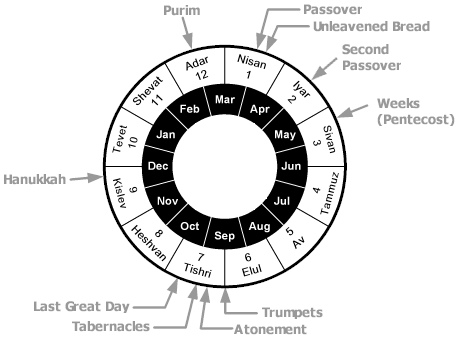 The Day of Atonement was the day of condemning, avenging and coverings of sin. On this day, the sins of the entire Jewish nation were covered over. Once a year on this day, the High Priest would dress in a plain linen robe. He would bathe, and sacrifices would be offered, and the people would pray and confess their sins. And then with the blood of the sacrifice in his hands, he would make his way through the Holy Place to the veil. Pushing it to one side, he would enter into the presence of God, and sprinkle the blood upon the lid of the Ark, the Mercy Seat, and pray for the people. And then he would exit, not to enter for another year.
So are these Holy feast days associated with the sanctuary and the whole sacrificial system? It absolutely cannot be debated. This is exactly what they were all about. This is why they pointed forward to the work of Jesus on the cross and why they were spiritually fulfilled and ended at the cross. How could and why would these things that made reconciliation for our sin continue after the cross? Did Jesus cover our sin or not? When Jesus proclaimed on the cross “it is finished” it was all accomplished. It is not possible to separate the sacrificial sanctuary system from the feasts as they were and integral and primary part of the sanctuary system. Just for a reminder and further clarity, what did Jesus end at the cross?
Ephesians 2:15 “Having ABOLISHED in his flesh the enmity, even the law of commandments contained in ordinances; for to make in himself of twain one new man, so making peace;”So did these ordinances that were handwritten by Moses, which had feasts, new moons, and ceremonial sabbaths include the feast Holy days? Firstly these feasts are the Holy feast days and we just observed in Ezekiel 45 that they did, but here is yet another of many verses that could be quoted that still further demonstrate this plain truth. This one adds the feast of weeks (Pentecost) and the feast of tabernacles.
2 Chronicles 8:13 “Even after a certain rate every day, offering according to the commandment of Moses, on the sabbaths, and on the new moons, and on the solemn feasts, three times in the year, even in the feast of unleavened bread, and in the feast of weeks, and in the feast of tabernacles.”Looking at the above verse, whose Commandments were these? God’s or Moses? God of course gave the Ten Commandments (Exodus 19-20). The ordinances were handwritten as Colossians 2:14 informs us, and by whose hand were these ordinances written by? Are the ordinances separate from the whole law?
2 Chronicles 33:8 “Neither will I any more remove the foot of Israel from out of the land which I have appointed for your fathers; so that they will take heed to do all that I have commanded them, according to the whole law AND the statutes AND the ordinances by the hand of Moses.”Luke 1:6 shows before the cross we had the Ten Commandments and the ordinances, which are clearly different things but what else shows that the ordinances were nailed to the cross with the New Covenant?
Luke 1:6 “And they were both righteous before God, walking in all the commandments AND ordinances of the Lord blameless.”So the Old Covenant had these ordinances that included the feast days that were part of the sanctuary service but does the New Covenant still have them? Hebrews 9:1 says the first Covenant “had also...” which means in addition to something else and Luke 1:6 above tells us what. So we see below that the New Covenant no longer have the ordinances so what is left? Quite simply, just the Ten Commandments!
Hebrews 9:1-2 “Then verily the first covenant had also ordinances of divine service, and a worldly sanctuary. 2 For there was a tabernacle made; the first, wherein was the candlestick, and the table, and the showbread; which is called the sanctuary.”Moving on just a few verses, again, what were these ordinances for that we saw once again are gone in the New Covenant and why did they end at the cross? And who became our high Priest and our final perfect sacrifice that ended these Holy feast days that pointed to the work of Christ on the cross?
Hebrews 9:10-14 “Which stood only in meats and drinks, [offerings] and divers washings, and carnal ordinances, imposed on them until the time of reformation. 11 But Christ being come an high priest of good things to come, by a greater and more perfect tabernacle, not made with hands, that is to say, not of this building; 12 Neither by the blood of goats and calves, but by his own blood he entered in once into the holy place, having obtained eternal redemption for us. 13 For if the blood of bulls and of goats, and the ashes of an heifer sprinkling the unclean, sanctifieth to the purifying of the flesh: 14 How much more shall the blood of Christ, who through the eternal Spirit offered himself without spot to God, purge your conscience from dead works to serve the living God?”Scriptures Used to Support Keeping the Feasts
Those that insist we should be keeping the Holy feast days use many scriptural references to support their argument which contradict Paul and many other passages. But why do more than 95% of the scriptures they quote occur before the cross? Since theses feasts ended at the cross, then it becomes pretty pointless to quote scriptures of anyone keeping the feasts before the cross as they would of course still be keeping them then! They are clearly very anxious for others accept their heresy, but to quote so many scriptures that are irrelevant is very strange as the truth seekers are going to realize they are before the cross and see right through this. They will lose credibility with the wise when they do this but perhaps that is a good thing as it helps others to see the truth and not get led astray by this incorrect teaching. If you feel a particular scripture is not perfectly clear, we can still be sure by the fact that Paul and the Bible never contradicts himself or itself. I am not going to waste your time covering the scriptures that were before their literal fulfilment as I think these are very clear and easy to see.
NOTE: It is very significant that the Jews especially were still keeping these feasts while Gentile Christians who heard the Gospel and accepted Christ were not. So why were Jews keeping them but not the Gentiles? The Gentiles had never kept them before but now the Gospel was also for them, the Gentiles which accepted Christ knew there was no obligation to keep the feasts as they had ended. Let's go back to a previously discussed scripture for even more clarity on this very important point.
Ephesians 2:15 “Having abolished in his flesh the enmity, even the law of commandments contained in ordinances;...”Albert Barnes' Notes on the Bible (1798-1870)
“The enmity - Between the Jew and the Gentile. Tyndale renders this, “the cause of hatred, that is to say, the law of commandments contained in the law written.” This is expressive of the true sense. The idea is, that the ceremonial law of the Jews, on which they so much prided themselves, was the cause of the hostility existing between them. That made them different people, and laid the foundation for the alienation which existed between them. They had different laws; different institutions; a different religion. The Jews looked upon themselves as the favorites of heaven, and as in possession of the knowledge of the only way of salvation; the Gentiles regarded their laws with contempt, and looked upon the unique institutions with scorn. When Christ came and abolished by his death their special ceremonial laws, of course the cause of this alienation ceased.Even the law of commandments - The law of positive commandments. This does not refer to the “moral” law, which was not the cause of the alienation, and which was not abolished by the death of Christ, but to the laws commanding sacrifices, festivals, fasts, etc., which constituted the uniqueness of the Jewish system. These were the occasion of the enmity between the Jews and the Gentiles, and these were abolished by the great sacrifice which the Redeemer made; and of course when that was made, the purpose for which these laws were instituted was accomplished, and they ceased to be of value and to be binding.
Contained in ordinances - In the Mosaic commandments. The word “ordinance” means, decree, edict, law; Luke 2:1; Acts 16:4; Acts 17:7; Colossians 2:14.”
So after the cross Jews were still keeping the feasts “contained in ordinances” as described in Colossians 2:16 that Paul mentioned in verse 14 (as also mentioned in the above Commentary) as they had not heard the Gospel and did not know that Christ brought an end to them. But the Gentile Christians were not keeping them as they had never kept them before and understood from the Gospel message that they had in fact ended. So Paul really had his work cut out for him in trying to get through to the Jews that they no longer had to keep them either. Attending the feasts that were still being kept by the Jews was of course the perfect time to do this and so Paul would have attended them all for this purpose.
Passover - Leviticus 23:4-5
1 Corinthians 11:23-29 - In this passage, Paul speaks of communion which was first instituted on Passover as this was the perfect opportunity before His death. 1 Corinthians 11:26 says “For AS OFTEN [as often as you choose] as you eat this bread, and drink this cup, you do show the Lord's death till he come.” The death of Christ replaced Passover as He became our Passover. Parentheses are added.
Unleavened Bread - Leviticus 23:6-8
Acts 20:6 - Reads, “after the days of unleavened bread” with no reference to it actually being kept. See Commentary below.
John Gill's Exposition of the Entire Bible. Dr. John Gill (1690-1771)
“after the days of unleavened bread; or the passover; which is mentioned only to observe the time of year when this voyage was taken; and not to suggest to us that Paul and his company stayed at Philippi, and kept this feast there; for the passover was only kept at Jerusalem, and besides was now abolished, and not to be observed by Christians:”1 Corinthians 5:8 “Therefore let us keep the feast, not with old leaven, neither with the leaven of malice and wickedness; but with the unleavened bread of sincerity and truth.”
When you look at the context of this passage, you can see that Paul is not speaking literally of keeping the feast, but is symbolically saying that Christian’s should continually keep themselves free from the defilement of sin. That is, “old leaven” should be kept purged from his soul. Paul is using this symbolic example to show that in the same way a little leaven leavens a whole mass of dough, so just one sin or sinner can send a corrupting influence through the whole church. Here are two Commentaries for clarity.
The People's New Testament (1891) by B. W. Johnson
“Let us keep the feast. Let us keep feast, or festival. There is no article in the Greek. The reference is not to the Lord's Supper, or to Easter, as some have supposed, so much as to a constant duty. We always have a Paschal Lamb; hence it is always our duty to keep festival by casting out all leaven; either the old leaven of heathen vice, or of malice and wickedness, or any sin.”Albert Barnes' Notes on the Bible (1798-1870)
“Let us keep the feast - Margin, “Holy day” ἑορτάζωμεν heortazōmen. This is language drawn from the paschal feast, and is used by Paul frequently to carry out and apply his illustration. It does not mean literally the paschal supper here - for that had ceased to be observed by Christians - nor the Lord’s Supper particularly; but the sense is “As the Jews when they celebrated the paschal supper, on the slaying and sacrifice of the paschal lamb, put away all leaven - as emblematic of sin - so let us, in the slaying of our sacrifice, and in all the duties, institutions and events consequent thereon, put away all wickedness from our hearts as individuals, and from our societies and churches. Let us engage in the service of God putting away by all evil.”Not with the old leaven - Not under the influence, or in the indulgence of the feelings of corrupt and unrenewed human nature - The word “leaven” is very expressive of that former or “old” condition, and denotes the corrupt and corrupting passions of our nature before it is renewed.
The leaven of malice - Of unkindness and evil - which would diffuse itself, and pervade the mass of Christians. The word “malice” (κακίας kakias) denotes “evil” in general.
And wickedness - Sin; evil. There is a particular reference here to the case of the incestuous person. Paul means that all wickedness should be put away from those who had been saved by the sacrifice of their “Passover,” Christ; and, therefore, this sin in a special manner.
But with the unleavened bread ... - That is, with sincerity and truth. Let us be sincere, and true, and faithful; as the Jews partook of bread unleavened, which was emblematic of purity, so let us be sincere and true. It is implied here that this could not be done unless they would put away the incestuous person - No Christians can have, or give evidence of sincerity, who are not willing to put away all sin.”
Before discussing the next one, remember the issue of the enmity between the Jews and Gentiles and consider the following. How many Jews had heard the Gospel just after the cross and what was the task given to Paul and the disciples? The Jews had being habitually keeping these Holy feast days for centuries and none of them would know the feasts had ended unless someone told them. So how do you tell such a massive number of Jews the Gospel message that means no longer having to keep the feasts? This would be a monumental task that could take a lifetime. There would have to be an easier way!
Ideally you would need to find all God fearing Jews altogether in the same place at the same time. So was there any event that occurred in those days where you would find all the Jews in the same place at the same time? There was in fact. To state the obvious, the feast days themselves! Thus everyone that had not heard the good news would be present and you could tell them all at the same time while preaching the good news to the crowds. This would sure make the job a lot easier wouldn’t it?
So if you were Paul, would you attend the feasts since everyone who had not heard the Gospel would be in the same place at the same time so you could tell everyone in one easy speech? One would of course realize this was the perfect opportunity to do this! Any other way would be just plain foolishness!
Now Paul was obviously not saying, these ordinances (Mosaic Law) are against you.., SO KEEP DOING THEM, they are contrary to you.., SO KEEPING DOING THEM, and they were nailed to the cross.., SO KEEPING DOING THEM. So do not let anyone judge you for STILL KEEPING these sacrificial meat and drink offerings, Holy feast days, new moon festivals and the yearly sabbaths that I have just said was AGAINST YOU, and CONTRARY TO YOU, and WERE NAILED TO THE CROSS! Believe it or not there are some that will tell you that this is what Paul was saying! After debating this with one person to the point where he had no where left to go, he left me speechless with this most ridiculous statement, “The passage does not say what it appears to say!”
Some will also try and tell you that only the sacrificing of animals was done away with but the Holy feast days still have to be kept. Nowhere does scripture say this or separate them! In Colossians 2:14-16, Paul says that it is the meat and drink offerings, Holy feast days, new moon festivals and the yearly sabbaths that were part of the ordinances and all these were nailed to the cross as described by Paul in verse 16.
So if Paul says these ordinances are contrary to us and against us and bondage and were nailed to the cross, is he going to keep them? Of course not! So why did Paul try to attend the feasts when it was possible as stated below? For the same reason we would if we were Paul. There was no better opportunity to teach the truth and preach the Gospel. This would be the perfect time as all Bible Commentaries state.
Pentecost - Leviticus 23:15-21
Acts 20:16 “For Paul had determined to sail by Ephesus, because he would not spend the time in Asia: for he hasted, if it were possible for him, to be at Jerusalem the day of Pentecost.”
Does Paul say that he is personally going to keep this feast or that he wants to be there on that day? Paul in no way implies he is keeping this feast but if possible wants to be in Jerusalem on that day. Why? Below are two trusted Commentaries for clarity and the obvious answer previously discussed.
John Gill's Exposition of the Entire Bible. Dr. John Gill (1690-1771)
“for he hasted, if it were possible, for him to be at Jerusalem the day of Pentecost: which was near at hand; for it was but fifty days from the second day of the Passover, which feast was over when he sailed from Philippi; and at Troas he stayed seven days, and he had been several days sailing already; see Act_20:6. And his great desire to be at the feast of Pentecost was not in order to keep that feast, according to the usage of the Jews; but that he might have an opportunity of preaching the Gospel to a great number of Jews, out of all countries, whom he knew would come to that feast.”Adam Clarke's Commentary on the Bible, LL.D., F.S.A., (1715-1832)
“To be at Jerusalem the day of Pentecost - That he might have the opportunity of preaching the kingdom of God to multitudes of Jews from different places, who would come up to Jerusalem at that feast; and then he no doubt expected to see there a renewal of that day of Pentecost in which the Spirit was poured out on the disciples, and in consequence of which so many were converted to God.”1 Corinthians 16:8 “But I will tarry at Ephesus until Pentecost.” An invalid argument as Paul does not say or even imply he is going to keep this feast. Let Paul explain for himself why he wanted to stay around until this time in the verse that follows. 1 Corinthians 16:9 “because a great door for effective work has opened to me, and there are many who oppose me.” Paul chose to stay around to do the work he had been commissioned to do and undo any damage from those who opposed him. See Commentary below.
John Gill's Exposition of the Entire Bible. Dr. John Gill (1690-1771)
“But I will tarry at Ephesus till Pentecost. The feast of weeks, or of harvest, which was fifty days from the Passover; See Gill on Act_2:1 which though abrogated at the death of Christ, was observed by the Jews, and is mentioned by the apostle, not as a festival that the Christians were obliged to regard, or did regard, but as pointing out the time he intended to stay at Ephesus: and we elsewhere read, that he was greatly desirous of being at Jerusalem on the day of Pentecost, Act_20:16 not to keep it, but because there would then be abundance of people from all parts there, to whom he should have an opportunity of preaching the Gospel.”Acts 18:21 “But bade them farewell, saying, I must by all means keep this feast that cometh in Jerusalem: but I will return again unto you, if God will. And he sailed from Ephesus.”
This is one the most pushed verses as you would expect. But they fail to mention that the majority of Bible versions very significantly omit the phrase “I must by all means keep this feast that cometh in Jerusalem” such as the Amplified, ASV, BBE, CEV, CJB, CENT, DRB, ESV, GNB, GW, HCSB, ISV, MRC, MSG, NASB, NIRV, NIV, NLT, NLV, NRSV, RSV, RSVA, RV, TCNT, UPDV, WNET and WNT. The Darby greys out this text and like the King James Version, when it is greyed out, it means it is added text. Acts 18:21 “but bade them farewell, saying, I must by all means keep the coming feast at Jerusalem; I will return to you again, if God will: and he sailed away from Ephesus.”The Commentary below explains.
Adam Clarke's Commentary on the Bible, LL.D., F.S.A., (1715-1832)
“I must - keep this feast - Most likely the Passover, at which he wished to attend for the purpose of seeing many of his friends, and having the most favorable opportunity to preach the Gospel to thousands who would attend at Jerusalem on that occasion. The whole of this clause, I must by all means keep this feast that cometh in Jerusalem, is wanting [not there] in ABE, six others; with the Coptic, Ethiopic, Armenian, and Vulgate. Griesbach leaves it in the text, with the mark of doubtfulness; ... Without this clause the verse will read thus: But he bade them farewell, saying, I will return again unto you, if God will.” Parenthesis added.So this commentary says that without the added text, this verse would just say, “But bade them farewell, saying, I will return again unto you, if God will. And he sailed from Ephesus.” There are a few texts in the Bible that have been added by overzealous people in the early centuries that had their own ideas of what particular verses should say that were not the original inspired words of God, and this is one of them.
Even if this text was legitimate, it would be for the reason given by the two Commentaries below that obviously did not know this text was added. The Jews kept the feasts after the cross as they did not accept Jesus as the Messiah. But this was a great opportunity for Paul to preach the Gospel to the right people in all the one place at the same time. So Paul would have tried to attend all these Jewish festivals.
Albert Barnes' Notes on the Bible (1798-1870)
“Keep this feast - Probably the Passover is here referred to. Why he was so anxious to celebrate that feast at Jerusalem, the historian has not informed us. It is probable, however, that he wished to meet as many of his countrymen as possible, and to remove, if practicable, the prejudices which had everywhere been raised against him, Act_21:20-21. Perhaps, also, he supposed that there would be many Christian converts present, whom he might meet also.”Robert Jamieson, A. R. Fausset and David Brown
“I must ... keep this feast - probably Pentecost, presenting a noble opportunity of preaching the Gospel.”Trumpets - Leviticus 23:23-25
Matthew 24:30-31; 1 Thessalonians 4:16-17; Revelation 11:15 - These verses refer to the sound of the trumpet blown with the second coming of Christ and are INCORRECTLY and perhaps dishonestly linked to the blowing of trumpets which was done just before the Day of Atonement. There is nothing here but erroneous assumptions to imply Paul kept the feasts that he said were nailed to the cross.
There is no doubt about the fourth and the other nine Commandments being eternal but the feasts had a purpose. The Bible tells us that they were our schoolmaster to bring us to Christ but then were no longer necessary. (Galatians 3:24-25) What was it that these feasts also had? They had sacrificial offerings to make reconciliation for our sin. When Jesus said “it is finished,” had he finished the job or not? There was certainly something nailed to the cross. So what was nailed to the cross? It was whatever it was that was practised to make reconciliation for sin before Christ died on the cross. These feasts had burnt offerings etc. If one insists they must keep these feasts then they have to do it properly according to how the Bible instructs they are to be kept. You cannot just decide what part of them you want to do. You do it all or you don't do it at all. Here is just one example for Passover. If one insists on keeping these feasts, then this is what you have to do for Passover just to begin with!
Ezekiel 45:21-25 “In the first month, in the fourteenth day of the month, you shall have the passover, a feast of seven days; unleavened bread shall be eaten. 22 And upon that day shall the prince prepare for himself and for all the people of the land a bullock for a sin offering. 23 And seven days of the feast he shall prepare a burnt offering to the LORD, seven bullocks and seven rams without blemish daily the seven days; and a kid of the goats daily for a sin offering. 24 And he shall prepare a meat offering of an ephah for a bullock, and an ephah for a ram, and an hin of oil for an ephah. 25 In the seventh month, in the fifteenth day of the month, shall he do the like in the feast of the seven days, according to the sin offering, according to the burnt offering, and according to the meat offering, and according to the oil.”Now here is the problem. If you start doing burnt offerings to make reconciliation for sin then you say to Jesus, “Hey Jesus! When you said it was finished, it was not finished at all…You did not finish the job on the cross at all so I still have to follow these feasts and the burnt offerings etc to cover my sins…”
I would hope no one would want to deny the work of Jesus on the cross! This is why they were nailed to the cross, as Jesus fulfilled this sacrificial system with these feast days. I know what the COG teaches and all the other offshoots of the WWCG, which Herbert Armstrong taught who yes, were proven to be wrong on many things including the feasts etc, and he was found to be a cult leader and why the Church collapsed. The problem is that the enemy is recruiting more and more people into this system he started.
Galatians 3:10 “All who rely on observing the [Mosaic] law are under a curse, for it is written: Cursed is everyone who does not continue to do everything written in the Book of the Law.” Parentheses added.
Those who keep the feasts claim that only the sacrificial law was nailed to the cross and the feast days remain but the above verse from Paul says not so. If you are going to keep these feasts that are written in the Book of the Law then you have to keep everything including the sacrifices or you are cursed!
The Contemporary English Version translates Galatians 3:10 this way. “Anyone who tries to please God by obeying the [Mosaic] Law is under a curse. The Scriptures say, “Everyone who doesn't obey everything in the [Book of the] Law is under a curse.” Parentheses added.
Before concluding this document, here are four more erroneous arguments I have heard so I will cover them in brief. First it was stated that Colossians 2:16 says “let no man” and by looking at other scriptures using this phrase, it was argued that these were people outside of the Church so therefore Paul was saying do not let people judge you for still keeping them! It is a fool's theology to say this verse here says this so therefore this one must mean the same thing! The fact that Paul and the context of this passage says that these were against us and were nailed to the cross did not even enter into the equation. “Let no man” in this case means just that. In the Church or outside the Church makes no difference to what Paul is saying anyway. Paul says these ordinances are abolished and that applies to everyone.
And secondly, it was argued that since verse 17 in the KJV says, “which ARE a shadow of things to come” that this must refer to after the cross and so the feasts are still valid. Firstly, the learned know that translating Greek to English is not an exact science and that you cannot hinge an argument on one word such as “are,” and especially when it contradicts other black and white scriptures such as verse 14 and 16. Secondly, the Greek word for “are” (esti) means “third person singular” and hence is not necessarily the word “are” anyway, and so some translations use the word “were” instead of “are” such as the first two below, which are also correct. Thirdly, this argument would contradict Paul saying the feast days are against us and nailed to the cross. Fourthly, Paul is speaking past tense as in these feasts that were kept in the past pointed forward to the future of when Christ died on the cross. And last, most translations more clearly say something like “what was to come,” and since most feasts have met their literal fulfilment, then “what was to come” that gave the shadow would be gone now anyway making this argument irrelevant. Below are some other translations that verify the above points.
			(WNT) These were a shadow of things that were soon to come, but the substance belongs to Christ.

(NCV) These things were like a shadow of what was to come. But what is true and real has come and is found in Christ.

			(NIV) These are a shadow of the things that were to come; the reality, however, is found in Christ.

(CEV) These things are only a shadow of what was to come. But Christ is real!

(NASB) things which are a mere shadow of what is to come; but the substance belongs to Christ.

			(NIRV) They are only a shadow of the things that were going to come. But what is real is found in Christ.

			(RSV) These are only a shadow of what is to come; but the substance belongs to Christ.
The third is Zechariah 14 where it speaks of keeping the feast of tabernacles. This chapter is a conditional prophecy that is a description of events in connection with the second coming in terms of how this event would have come about if the Israelites who returned from captivity had fulfilled their destiny. They did not so it does not apply. Not only that but verse 21 says it includes sacrifices so this is before the cross!
And the fourth is that some say Matthew 5 refers to the ceremonial law also but it can only refer to the Ten Commandments as proven by the context of the rest of the chapter, which refers to the moral law only. There is not even a hint of the feast system being referred to in the entire chapter.
Those teaching observance of the feasts also typically use underhanded techniques like painting an ugly picture for Easter and Christmas to try and turn people from them and then to their Church for the answer to escape this. Yes, there is paganism involved in the origin of these things that one can easily avoid, and do not forget that Satan wants this to happen and for these two events to be lost as much as possible because they do result in many people coming to Christ. If the world followed Armstrong's teaching then the world would never here about Christ and that is exactly what Satan wants. Jesus out of the picture! He also wants to add confusion here to keep as many as possible from the fourth Commandment that really is important. It is sin not to keep the Commandments but this feast system was to make reconciliation for sin (breaking the Ten Commandments) and pointed forward to Christ. Big difference! We need to understand this. And yes, we have just seen there are some verses that can be cleverly used and misunderstood to make a convincing argument but there are clear answers to these scriptures if one wants them that also prevents all the contradiction with other scripture that you would otherwise have.
We must not deny the work of Jesus on the cross and in turn add to the confusion that will keep more people from finding the blessings of the Sabbath truth and entering the kingdom.
Colossians 2:16 Conclusion:
Colossians 2:14-17 “Blotting out the handwriting of ordinances that was against us, which was contrary to us, and took it out of the way, nailing it to his cross; … 16 Let no man therefore judge you in meat, or in drink [offerings], or in respect of an holyday, or of the new moon, or of the sabbath days: 17 Which are a shadow of things to come; but the body is of Christ.”So to paraphrase this passage, Paul is saying, “These ordinances that had meat and drink offerings, new moon festivals, holydays and sabbath days are now against us and contrary to us and hence are bondage and are nailed to the cross. So therefore don’t let anyone judge for no longer keeping these meat and drink offerings, new moon festivals, holydays and sabbath days that are now against you as they have been nailed to the cross and hence are gone and no more.”
It is extraordinary that this verse requires such long winded explanations for what should be blatantly obvious to any studious Christian looking for truth, but I also understand that the enemy has no trouble in finding people he can deceive and encourage others to follow them in order that confusion reigns. So let’s just put the simple facts forward just one more time. See also Wednesday crucifixion theory.
The ordinances were handwritten by Moses, they were bondage and against us and because they were the sacrificial part of the Law of Moses, they were no longer required after the cross and so were nailed to the cross. Paul informs us that these ordinances had meat and drink offerings, feast holydays, new moon festivals and various ceremonial Sabbaths, which were a shadow of what was to come. This is a perfect parallel to all other related Bible passages and the context is perfect. So is Paul saying don’t let anyone judge you for keeping or not keeping these ordinances that were AGAINST US and NAILED to the cross?